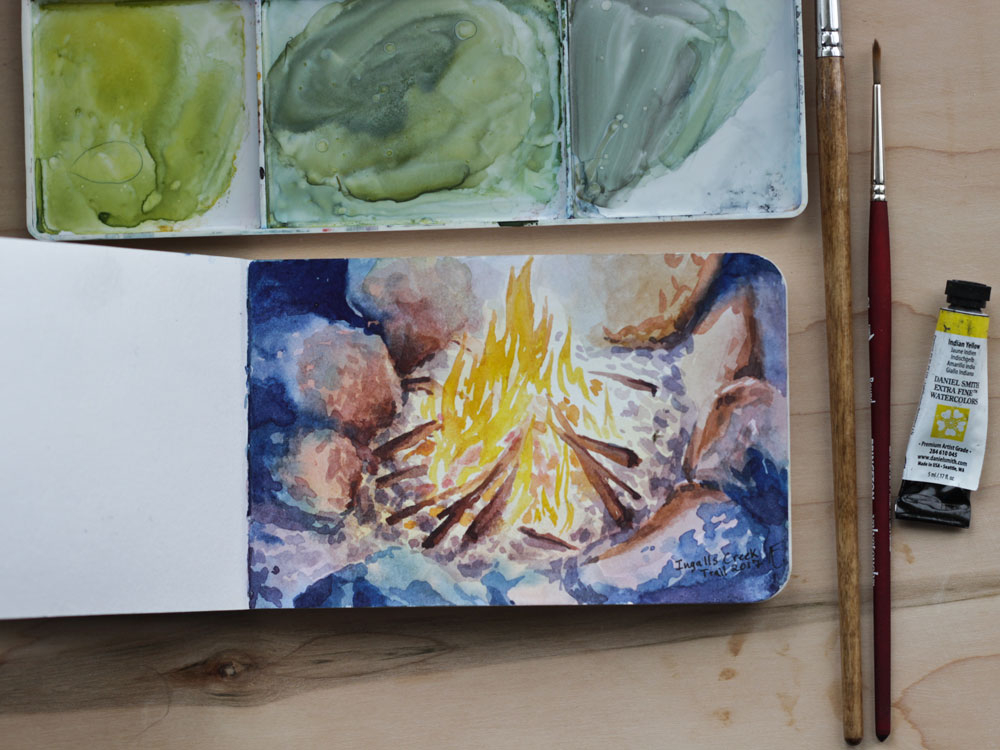
One type of art that helps replenish my love of life and fills my soul is Plein Air Painting.
Plein Air, translated from French into English, means 'outdoor', and that is the exact idea behind it; you leave the photos behind, leave the computer behind, pack your drawing materials, your painting materials, and head out to location, painting or drawing from sight.
Though plein air implies painting, or drawing, in the outdoors, sometimes sitting in a coffee shop or restaurant works just fine. 'People watching' becomes necessary for educational purposes when one engages in plein air painting, and the lessons learned from in-person work are irreplaceable.
Most of my experiences with plein air painting involves naturalistic places and subjects. When I go on hikes, or can grab some alone time for myself during camp outs, I prefer to take a little time to watercolor paint. Sitting spaces jump between rocks, logs, dirt, and just about anything that allows me to place my palette down flat. Well, mostly flat.
When I paint I do so with watercolors for time's sake; watercolor set up is quick, it's easy to make a small case to pack in and out, and I can usually spit out a full mini painting in one hour, making it perfect for getting a hike in as well, either before or after painting.
My case is simple; I bought a box with a small latch at a craft store, cut a small piece of light weight thin wood to use to clip my paper or mini sketchbook to, I bring two small clips, a Stillman & Birn mini watercolor book - Beta or Zeta series works great -, a small watercolor tray that closes all the way that includes space to mix, not just store paints, paper towels, a small thing of salt, a couple small paint brushes that fit in the box all the way, and occasionally I'll bring the small tubes of paint - I use Winsor & Newton Series 3 or 4, and am now giving Daniel Smith paints a try - to replace the paints in the case. Though I have the wood box, and that's what I started with, I recently bought and Art Bin to transfer things into. The bin can separate things a little more, allows for a TINY bit more room, and it feels more robust, less likely to be dropped and hinges break on me, or the clasp give way and everything tumble out.
I have a few large trays for watercolor painting, some forty colors in one of those trays, but honestly I've forgotten the majority of those colors and the tray. What I use now are the mini travel trays, even for my painting at home, and the five colors I use in those trays. My preferred method is to stick with a color scheme per mini tray; I'll pick the tone of yellow I want, the tone of red I want, and the tone of blue I want. On top of those three I might add a second red if I feel I need a colder or warmer tone that I can't get from the original choice, and I'll usually have a black or Payne's gray placed at one end of the tray. Sometimes going back to the most basic of color theory can simplify your process and create a unity in your paintings you might not gain otherwise. It allows me to relax more and not worry about deep color theory, and instead I can focus on pumping out a decent, nice little painting in the time allotted.
My favorite part about plein air painting is getting out, sometimes with music, and rarely being needed, interrupted, or surrounded by too many people. I can get away from my home where all the chores are constantly calling my name, where interruptions are unrelenting, and where I am NEVER alone. I think plein air painting was created by introverts.
The idea of going out plein air painting was introduced two ways to me; the first was through James Gurney. He creates within his studio as well, but his Color and Light book showed several plein air paintings, and his youtube and instagram had many videos and images on his outdoor painting adventures. The thought arose within me while looking through his pictures and videos "I can combine being outside AND art? I can do that? I thought that was only for fine art oil painters!". Thoughts like that floated around in my mind, and I dabbled a bit here and there in plein air painting, but didn't make much effort towards it until my friend Hannah(THANK YOU) began talking of it and we had the opportunity to go out a few times. She showed me the idea of having a little painting kit, or a Pochade Box, and how fun they could be to put together. I now have two of them that I swap between. I tried to keep costs low so I could focus on getting to the painting side of things rather than caught up in my pochade box design, but I have since saved many ideas on how to design and redesign my painting set up. Also, I found that James Gurney created a facebook group that focuses on plein air painting and Pochade box designing, which is very insightful and fun to browse through. I feel as if my own set up is still in it's infant stages so seeing how others have developed their boxes helps me plan for the future.
Plein air painting is still new to me in many ways, and I hope to find more time for it as my children grow older and are less dependent on me. My goal in the future is to get out a couple times each week to different places just to paint a little bit, and probably get a hike in as well. I need practice drawing buildings and people from life, but my heart will always remain in the wild places of the world.
In my mind dragons represent the height of fantasy, the best of mythical creatures, a beast with endless possibilities. I've found that I love them in any form; from god-like to demonic, from beast to sentient being, laughable and loveable to terrifying and horrific, and from simply a physical creature to a thing of magic and awe. Their designs are almost as extensive and flexible as those of humans, where as I find other races within fantasy rather limited and living within specific characteristics. Those other races, though still wonderful, are not as versatile as dragons.
I get stuck on the things I love in art the most; armor, action poses, buildings, and dragons.
So here we are, in the month of August, and on many social media platforms the drawing prompt for this month is called 'Smaugust', or the month of dragons, named in honor of J. R. R. Tolkien's dragon Smaug from The Hobbit. I don't participate in every month's drawing prompts, but once in a while I see one that I think fits with what I am trying to accomplish. So for the month of August, for Smaugust, I took a little time to draw, for the fun of it, a chubby dragon. I used a little reference, mostly of a fat cat curled up, paws tucked in, looking rather content and probably purring. I'm sure my dragon is purring as well...or snoring. Probably snoring from the looks of it.
Sometimes I forget that I love drawing. Sometimes I forget that I want to paint. There are even times that I huff and puff about having to design an image with an awesome, inspiring subject. And yet, even with all this terrible-two-year-old attitude, I still stand with my nose in the air, proclaiming that I'm an artist and that I want to work at it full time the rest of my life.
So why all the temper tantrums, grumbling, complaining, and avoiding of work?
Well, I've noticed that if you study something on your own time long enough two things can, and most likely will, happen;
1.) You will get in the mindset that you know what you're doing so you just need to get the job done. In essence, you stop asking *questions. Which makes you miserable, even if you don't notice it at first.
2.) You will keep a curious mind, an explorer's mind, and experiment continually, making educated guesses, relearning the wheel and realizing that there's always something you saw wrong, something you didn't completely see, something you miss interpreted, or something you didn't notice at all. Here you keep asking *questions.
More often than not we end up jumping between the two, becoming stagnant when we don't stay curious, and then eventually turning things around because we realize the loathing we've built up for something that is a part of us, that we used to love. Maybe at times there are good excuses as to why we just "push through" a project rather than open our minds up to the opportunities to ask questions, grow, and learn. All excuses are, however, like what my husband says, "excuses are like butts; everybody has one and they all stink." Some excuses seem very legitimate, and we can always tell how right or terrible our excuses are by how often we give them, and by how important they are in comparison to our goal, project, and future. This is one of the reasons why curiosity and questioning is so important. When we get to the excuses and loathing stage it's like there's a tall stone wall there, difficult to climb and on the other side of the wall is our work. Problem is that it takes so long to get through the scrapes of complaint, the pull-ups of frustration, and the hand cramps of detest that by the time we've made it to the work aspect night has come on and we create a half passable piece of junk in the gloom that leaves us feeling unsatisfied and our understanding of our talents diminished. At times I feel like days pass when I'm in this mindset because instead of even climbing the wall I'm stuck trying to break it down by smashing my head against it again and again.
There is, remarkably, an easier way to go about this whole thing though!
Let curiosity lead you a little, observe your wall, question it's purpose, ignore the idea of climbing it - and head bashing it - and instead enjoy learning about it. You might just find that there are doors, keys, sometimes a friendly guide or two, that can help you traverse the wall and start work on the other side with plenty of light to spare. Suddenly, questions have led you to avoiding what could have been a painful, annoying, and more often than not, pointless ordeal.
Questions move us forward, and not just the questions, but following through with actions. Why is it that some people lean towards certain design elements, color themes connect with emotions, or specific paintings touch people in such a way that they are willing to spend fortunes on them, or the artist devotes all of their time, soul, and energy to a singular style of work? Sometimes the questions that lead to amazing images are very simple, like how does a medieval traveler dress, or what is a realistic shape for a spacecraft so it will actually "fly" through the cosmos? What are marriage customs across the world, and what is happening with the bones and muscles of a human body when they contort in mid air after tripping?
Other questions can control the entire way you make art; Where do I stand as a person in this life? What emotions do I want to send from myself, to image, and to the thousands, or millions, of people that might see it? How do I see color? Do other people see color and values the same way I do?
There are an endless amount of questions, some with solid answers, and others with no answer, and some with multiple or vague answers. It is, after all, an art all it's own; the art of questions.
Going back to what I mentioned before, about studying something on your own time; I have found that even through every class, every school, every article, every opinion, demo, speech, discussion, tutorial, report, and film, nothing compares to what you learn while studying something on your own time because you want to learn about it. For example, I have sat down and watched videos of other painters and read their blog posts, and I have had great epiphanies about how to go about my art. Those tend to jump up hot and vibrant in my mind, like the explosion of molten lava from a volcano. But as time goes on, if I don't sit down and experiment on that epiphany there's a good chance that it will cool over time and slip back down into the deep realm of forgotten knowledge. However, if I take that epiphany, thought, or idea, and sit down, do the research, play with the new materials and mediums, experiment with the value concepts or color combinations, then that molten hot bit of knowledge is discovered, polished, and found to be a gemstone, something that can be, when properly cut and polished even more, worth so much more than just the epiphany it had been. The time we put into something can help make it's true worth come out, whether for good or bad. The only way to know if it is worthwhile or not is to put the time into it.
This is where the process comes in. Just like the stone wall can be a painful process to get through/over, the process of preparing our art, from concept to finished piece, can suck us of all energy, patience, and joy if we go about it without that touch of curiosity. At each step, from initial thought process, through rough thumbnails, to studying histories, stories, elements that might be vital to the image, value schemes, color schemes, maybe other artists to try an understand options and ideas that are similar or have been done well, to photo reference, costuming, lighting setups, finding a way to collect the right models, and then doing more detailed thumbnails from the gathered information, can be a beast to deal with. Let's now add to all of it the experimenting in photoshop if you do, piecing together photo references to have a better image to work from, and then prepping your surface or equipment properly, transferring any images to your work surface, and then slowly starting the process of actually making the art piece.
Yes, it really can be a beast! Lucky for us, we have curiosity and questions to guide us through! Each of these bits of the process are there to HELP not HINDER, so that by the time we get to the actual piece of work most of the hard parts are finished, we can see how our image will turn out to a degree simply by exploring it at it's most basic steps. Like strolling around the base of the wall with interest, finding a key, the door, helpers along the way, and putting forth the energy of the mind, we've simplified and taken control of the situation, asking the right questions where needed and being excited by each little discovery.
Some of my favorite parts of the process are thumbnail sketches, studying, and the photo shoot for reference - which shooting your own photos is waaaaay more fun than looking for similar ideas in stock photos online for hours. Plus it's a legitimate reason to stockpile costuming and write it all off in your taxes.
*To the left are the thumbnail sketches I began with, and they eventually evolved into what is on the right, which gave me direction on what photo reference I needed and ideas on color schemes.
Studying has to be one of my favorite things to do ever. I like to study just about everything, understand it all, and with art that opens so many ways as to how I can use that knowledge. For a specific image I love studying similar illustrations, maybe some golden age illustrators, master painters, or even more modern day artists. Usually this studying is done in regards to their image design, or perhaps their values or colors that are similar to how I want my own image to feel. At the moment I'm trying to slip out of what college roommates and I call the "rainbow vomit" phase of painting. For some it's the right place to be, but for me it screams "I HAVE NO IDEA HOW TO WORK WITH COLOR SO I PUT THEM ALL IN AS VIVID AS I CAN!". So studying other color palettes goes a long way to bettering my skills. Plus it's like master studies but all over my own drawing. In this I get to be curious about how other illustrators might paint my images, or better yet, I get to ask the question, "what if I can paint at that skill level?". This allows me to push myself with curiosity giving me energy and focus. It pushes away my doubts by just trying what the question hints at.
Photo reference shoots can be some of the most fun out of the whole process of creating a piece of art. Yes, it can be awkward, you have to work with another person or people, and set up can take time, but I have laughed soooooo much during this part of the process. My models have a great time, I get a ton of new images, some that might be useful for later as well, and more often than not I'm able to make great friendships, or contacts, start, or become stronger, through those photo shoots. On top of all that my curiosity tends to take over; I'm able to see new ways of interpreting my concept, some poses might actually work better than what I had originally thought, and my understanding of how the human body moves is deepened, which is important to my style of work. You can't completely control every aspect of how a photo shoot goes or how a person moves and expresses themselves, so you have to become flexible, allowing the questions to come forward.
YOU CAN DO IT!
I GIVE YOU PERMISSION!
BE CURIOUS!
ASK QUESTIONS!
It's time to mention those two groups I pointed out before, the one that asks questions and the one that doesn't; they are a cycle, but one of them is a trap and the other gives freedom and progression in your craft. You need to recognize when you've put yourself in the trap. The cool thing is that the key to your release is recognition and the courage to let go of your pride, open the door, and walk out to an ever changing world with endless questions and answers.
In the curiosity and willingness to learn is the happiness and excitement to your craft. You don't have to wait until the finished piece, you can have joy in the process now.
*Book suggestion; How To Get Ideas by Jack Foster
My first passion in life really was books! I spent almost all of my time reading, usually fantasy, but occasionally others as well. Fondest of all were books like the Redwall series by Brian Jaques, My Side of the Mountain and Julie of the Wolves by Jean Craighead George, and The Dark is Rising series by Susan Cooper. I still own all of these books today. While immersing my imagination in these delicious stories I stumbled upon the idea of art quite by accident; I remember searching for more books within the Redwall series on the internet (which was nothing like it is today!), and caught a glimpse of Ainsley Seago's artwork. It fit so perfectly with how I thought of the characters in the Redwall series that my eyes gobbled up every image and I saved all of her paintings that I could find! I had no idea what 'train' I had just climbed up into, but from Seago's artwork I found other websites showcasing similar art, usually referred to as 'anthropomorphic' or 'furry' art. I began trying to draw her little characters as well, copying a bit here and there to figure out how to draw faces, eyes, hands, bodies and feet.
Apparently I wasn't much good at it though, because during seventh grade, while just trying my hand at drawing I remember someone commenting on how terrible my images looked. This didn't deter me however; I have a rather stubborn streak, and whenever someone tells me I can't do something I tend to put all of my focus and energy into proving them wrong. Those comments and criticisms only spurred me on to show other's that I could learn to do whatever I wanted to. In the constant effort to gain experience I found other similar artists that fascinated me with their different styles and craftsmanship; Heather “Kyoht” Luterman and Christy “Goldenwolf” Grandjean were a few of the main influencers during that time, and I spent a lot of time leaning towards learning how to draw these more wolf and coyote style characters.At the time I also began dog sledding, and my artwork was influence heavily by that as well. I began drawing images of dogs, practicing drawing eyes, ears, and fur often, and I even managed to sell some artwork as teenager. Eventually I happened upon Tracy Butler as well, and that's where things began to take a turn in a different direction for me. Tracy's art, usually focusing on her stories as well, swapped between anthropomorphic art and humans, and it was her human drawings that drew me in. She had such beautiful drawing skills and details, especially with clothing and decorative patterns which was always hard for me. The constant influence and thirst for new artwork and ideas lead me to several different useful websites and people, ones that made me want to work harder and gain more experience. Deviant Art came into play at that point, and with it I found Stephanie Pui-Mun Law, Loish, and a number of other amazing individuals. The internet really was one of the most influential resources in my life, and is still incredibly useful. However, one of the people that has influenced me from my earliest of art days to today I didn't find on the internet at all, but on my sister's bookshelf; the covers on Anne McCaffrey's Dragon Riders of Pern books were spectacular, on a whole different level than anything I had ever considered trying before, and are painted by Michael Whelan. His combination of realistic lighting, color, anatomy, mixed with believable designs of fantasy worlds and creatures seemed so far out of reach to me, but spurred my imagination like no other. Especially, at the time, his dragons I found mesmerizing. How could anyone create such amazing images from their mind? I had no idea that people combined the use of photo reference and imagination to create paintings at this level.Diving into college I found other influences; gardening and plants, more books (Brandon Sanderson, Fablehaven, mostly fantasy), Anime, folklore, and other artists along the same lines as Michael Whelan, such as Jon Foster, Dan Dos Santos, Donato Giancola, Alan Lee, John Howe, Brian Froud, etc. Almost all of the individuals I began to follow were concept illustrators for games and movies, or book illustrators that focused on traditional painting, often larger images, and whose images were polished in a way I hadn't learned yet. I spent so much of my time trying to reach towards skills that confused me, that overwhelmed me, and with the expectation within myself that I should be able to do what all of these professionals with far more experience than I were doing. My mind reached and I felt like I failed time and time again while learning new mediums, such as the computer and oil painting, and while being constantly distracted by college expectations and needs. I spent five years in college and came out feeling so jumbled with knowledge that I didn't know how to use that as I tried to find work I became confused, afraid, insecure, and depressed.My artwork had come a long way, especially in my drawing and anatomy skills, but the rest looked foreign to me, as if someone else was creating it. Each piece I painted, whether for myself of a client, had it's moments that made me smile, and I was always happy to finish something, but then I would look at it and realize it wasn't at the level of craftsmanship I really wanted to be at. Why could I not figure this out?! It wasn't until much later, spending time on a mission for my church in Brasil, and starting life over in Arizona that I began to grasp what was wrong. I didn't actually like my own style of art.It wasn't bad, but it wasn't what I would ever follow, be in awe of, or even consider as a style to try and learn from. My colors were all wrong, my lighting wrong, more often than not I wasn't using proper photo reference, and I often compromised on letting parts of my drawings and paintings not reach a higher level for the sake of just getting something done. On top of all that, I wasn't planning out my images as fully as I could have or should have. I didn't like my own artwork. I had done whatever I felt was necessary to try and make my artwork work for my monetary needs (as in basic survival!), creating what I thought people wanted, had given up so much for it, and was miserable with the outcome. It was time to start over, learn to love making artwork again and being proud of what I was creating. Now is when those skills I had learned in college began to come back to me, but instead of letting all of that information overwhelm and confuse me I decided to pick out the pieces and bits that I felt worked with me and what I wanted. I wanted to be my master again and be excited about what I was learning and creating. At about that point, realizing what I wanted to do to reach my next tier of learning, my husband and I had our first child, and most of my ambitions came to a sudden screeching halt. It took me a while, to find a balance between giving to my family all that they needed from me, and making sure I was taking time for myself. I admit, I don't feel like I'm progressing as much as I'd like, but there is nothing that can replace me in the lives of my children, and I would never sacrifice my relationship with my husband, so my art time took a back seat. The break from doing art constantly, I think, was actually a life savor; this gave me time to think and contemplate what I wanted to achieve with my art, slowly plan out images, get better at photography for my own reference, and at the same time it meant I didn't have to feel like I was neglecting my family. Once my first child grew a little though I began to make efforts once more. This time I tried to see how far I could push myself, put forth some real effort to create an image I thought worthwhile. That's where my Direwolf painting came in. I never finished it though; my carpal tunnels began to have major issues whenever I painted digitally. The wacom tablet began to be pure torture and the most I could paint was for a half hour at a time, with several hours, or even a few days, of rest needed in between adding to the painting. I finally gave in and started drawing and painting traditionally, abandoning my digital painting skills, and starting all over again with real brushes.Again, I had a child, now two wonderful children in my life, but it didn't leave me worried about taking a break or slowing down my goals a little this time. Instead, it gave me a chance to focus on simple drawings, meeting other artists, learning more through watching tutorials, timelapses, reading articles like those in Muddy Colors, and summoning up the courage to show at events regularly for the first time. I was learning to face my fears, find new avenues to learn, and recognize the holes in my knowledge and abilities. These breaks gave me a chance to start over again and again, not clinging to old habits and expectations. They allowed me to become somewhat malleable again, willing to change, and willing to reassess what I really want to create and what my end goals are. My children are now both over one year old, and I have the chance to work a bit here and there. I do not take commissions so that I can focus on my education; there will always be time for work later when I'm creating the right kind of artwork to draw in clients with work I'm interested in. Until then, I take every minute I can to learn and grow. My focuses might seem spread out a bit, but I feel I am on the right track; -Proper image planning -Using reference photos -Drawing & Painting from life regularly (plein air) -Learning to use oil paints in a way I like -Continual study of art techniques (I watch several artists that help me learn what I think will help me get to where I want; Donato Giancola, Dan Dos Santos, Howard Lyon, Michael Whelan, James Gurney, Dave Santillanes, Vladimir Volegov, Justin & Anne Gerard, Alan Lee, and John Howe. There are several others that have passed away as well, old masters, art nouveau illustrators, and impressionists mostly) -Learning to paint environments -Testing more color theory ideas and combinationsAll of these areas are helping me reach my own expectations, little at a time. I'm spending more time finding joy in the process than worrying about getting huge full paintings done, and at the same time the level of craftsmanship and the general design of my art seems to be improving, hopefully in ways that will help me reach my goals.